Showing posts with label copyright. Show all posts

Wednesday, February 03, 2016

How copyright law makes Star Wars homage, not theft

The fever over Star Wars: The Force Awakens has faded now (we haven't posted about it in over a month!), but there's still plenty to dissect about it. One of the greatest criticisms of the movie was its tendency to retread themes, imagery, and structure from the original film – ignoring that the first movies explicitly, famously stole from classic action serials and samurai movies.

Rather than turn this into a creativity blame game, the Re:Create Coalition, an intellectual copyright law advocacy group, used this as an opportunity to explain the limits of copyright and the difference between infringement and expression. For one specific example, author Jonathan Band cites the early Tatooine scenes from A New Hope by comparing them to sequences and imagery from John Ford's classic Western The Searchers. This isn't theft since it's building on the ideas of an existing work and expressing it in a new way.

That's a tricky distinction in copyright law for any filmmaker, and Star Wars is a great example of how that can be navigated creatively. Band's article is mostly a list of examples connecting Star Wars to previous films, but they make a strong point: ideas are meant to be adapted, not restricted.

Thursday, December 10, 2015

The future of film copyright could rest in the Hands of Fate


Beloved by fans of Mystery Science Theater 3000 but unknown to the rest of the world, horror film Manos: The Hands of Fate is often considered the worst commercially released movie ever made. Nearly everything about the movie is a disaster, most famously the bizarre characterization and knee-heavy costuming of the evil henchman Torgo (pictured). Joel Hodgson described it as a movie where "every frame [...] looks like someone's last known photo."

Manos was recently re-released on Blu-ray, but as explained by Jonathan Bailey in Plagiarism Today, it might become the center of a landmark copyright battle. The producer of Manos neglected to copyright the film, leaving it in the public domain, but he did copyright the script before production. His son, inheritor of those rights, has threatened legal action – but no case has ever legally tested whether script ownership constitutes ownership of a public domain film. Bailey notes that similar cases have come up in the past, such as when story and soundtrack rights helped maintain control of It's a Wonderful Life, but Manos's case is far trickier.

(An interloper completely unrelated to the film's production has attempted to claim distribution rights, but that's a separate dispute.)

These specific ownership circumstances rarely happen, as proven by how this has never been tested. The answers could be a big moment for film copyright law, but Bailey sees little reason why such a thorny battle would end up in court given Manos's extremely low profile and revenue.

But we hope it does, if only so Manos can sneak into legal textbooks. Master would be pleased!

Thursday, December 06, 2012

At last! Free legal services for independent filmmakers

One of the most worrying parts of working on a big independent film project is the potential legal woes. Large producers tend to have lawyers on retainer, but for someone working on their capstone or getting feet wet in the world of independent filmmaking, a cease-and-desist over copyright or trademark infringement can be disruptive.

A fairly new group called New Media Rights is offering a solution. New Media Rights offers free literature and some legal services for aspiring filmmakers, YouTube mash-up artists, video game developers, and other independent creative content producers. This is a great resource for anyone having trouble navigating the murky world of fair use law.

Of course, you always could've gone to see Professor Aufderheide, but this is pretty good too.

Thursday, October 18, 2012

Learn about fair use next Thursday


Our friends at the Music Library were quick to remind us about the upcoming Digital Futures Forum to be hosted by the library next Thursday. This time around, the topic is the fair use of copyrighted material.

Fair use is often used as a blanket disclaimer for using copyrighted material, with some leeway provided for educational purposes, parody, and other creative uses. But fair use law has changed recently, especially in relation to changes in the Digital Millennium Copyright Act and the rise of streaming video services. Knowing the difference between arguable fair use and copyright infringement could save you great legal troubles. Copyright prosecution has actually happened at the university level; it's not a nebulous, unenforceable threat.

If you're planning on using video or other copyrighted content in projects this semester, be sure to learn the limits and privileges of fair use at the Digital Futures Forum next Thursday. For more information and to RSVP, email LibEvents@american.edu.

Tuesday, October 04, 2011

UCLA/AIME Streaming Video Lawsuit Dismissed

Librarians (particularly media librarians and copyright experts) who have been awaiting the outcome of the lawsuit filed by the Association for Information Media and Equipment (AIME) against UCLA in January 2010 can now stop waiting. The case has been dismissed, though on technical grounds that stop short of clarifying whether the practice UCLA engaged is acceptable under copyright law.

The lawsuit charged UCLA with breaking copyright law in streaming videos of complete BBC Shakespeare plays on a closed course management system without obtaining licensing. Part of the reason for dismissal is the existence of a sovereign immunity doctrine. UCLA as a state institution is immune from being sued in federal court. To put it in a local context, American University as a private university would not be protected by sovereign immunity.

The other cause for dismissal was lack of standing. AIME, though an association representing many copyright-holding companies, doesn't itself own the copyrights it alleges were infringed. Ambrose Video, the copyright owner, should have been the plaintiff.

There was no decision or opinion on UCLA's argument that a video purchased with Public Performance Rights could be streamed in its entirety without further licensing.

Link to ruling

A user-friendly summary of the decision can be found on Duke University's Scholarly Communications Blog

Saturday, January 08, 2011

How to Use HandBrake


HandBrake is free software available for Mac and PC that can assist in the circumvention of professional copyright protection measures on published media. Before proceeding with this tutorial or any other act which proposes to circumvent any copyright protection measures it is a good idea to take a look at the DMCA (Digital Millennium Copyright Act) and the "anti-circumvention exemptions" it provides. If the purpose of your actions is not found in the DMCA it may be that what you are attempting is illegal; tread carefully here.

This tutorial can assist you in using HandBrake to rip legally-defined clips from various media for educational or critical purposes:


Please note that Media Services staff CANNOT assist you in any act which attempts to break copyright measures.

Thursday, July 29, 2010

Good News! New DMCA exemptions benefit university faculty and students

On Monday, the Copyright Office announced new rules on exemptions from prohibition on circumvention of technological measures that control access to copyrighted works. Their words, not mine.

Ever since the Digital Millennium Copyright Act (DMCA) became law, faculty members and students alike have been legally hindered from using DVDs in the ways they had been able to use VHS videotapes in educational situations, such as clip compilations for class use. It made it illegal to break the encryption on DVDs for any reason. Over time new rules were released that enabled Film Studies professors to break the encryption for clip compilations. That was a step in the right direction but it didn't address the fact that visual media has become a hugely popular teaching aid for classes across the curriculum and it was just as likely that a literature or sociology professor would be interested in using clip compilations in their teaching.

Finally after a call-for-comments, hearings, and about a year of deliberation, the new set of rules has been released and there is real progress for the academic community.

To wit:
circumvention of the copy-protection on legally-acquired DVDs is permitted for the use of short portions of motion pictures in derivative works, for the purpose of criticism and comment, in the following instances:

(i) Educational uses by college and university professors and by college and university film and media studies students;
(ii) Documentary filmmaking;
(iii) Noncommercial videos.

There are additional rules but that change is the one that most directly impacts us.

Check the source: Rulemaking on Anticircumvention text

Monday, May 04, 2009

A bad idea gets worse...

Disney to remove all extras from rental DVDs as well Following in Fox's footsteps, Disney has announced that it will become the second studio to release two different "classes" of DVDs and Blu-ray Discs, a "premium" version, and a bare-bones rental version.

Starting in June with the movies Morning Light, Confessions of a Shopaholic and Jonas Brothers: The Concert Experience, the studio will offer the premium version with extras and other "value-added material" while also offering the cheaper stripped-down rental versions.

The move follows that of 20th Century Fox, however with some significant differences. Disney will offer the rental versions at a lower price point, whereas Fox offers both versions at the same price. Fox also controls what rental or retail outlets can buy, however Disney gives all companies the option to buy what they please.

The rental units will not be shrink wrapped and will have no promotional inserts inside either. For example, the Jonas Brothers premium DVD, with digital copy and bonus features, has a MSRP of $39.99 USD while the single disc rental version will have the movie only, and has an MSRP of $29.99 USD.

Retailers seemed to generally respect the decision. “That is all we care about,” added one executive. “Not only do you have the difference in price, but retailers can buy either version.”

Fox has been having issues with their decision recently, and is even considering dissolving their DVD class separation.

Saturday, May 19, 2007

A Fair(y) Use Tale - a must-see primer on copyright law

Professor Eric Faden of Bucknell University tweaks the noses of the Disney lawyers with this introduction to copyright - done with dozens of brief clips from Disney films used under the fair use guidelines. I'll assume readers are aware of Disney's extraordinary litigious history in this area.

link

Tuesday, April 25, 2006

Upcoming event from the Center for Social Media - May 3


The Center for Social Media at AU and Women in Film and Video will be holding a session "Getting the Rights Right" on Wednesday, May 3. Everything filmmakers should know about copyright, public domain, creative commons and fair use. Panelists include: Pat Aufderheide, Director of the Center for Social Media, School of Communications, AU; Lauren Cardillo, Independent Producer; Bonnie Rowan, Researcher; Dolly Turner, Music Industry Executive, and Laura Possessky, Entertainment Lawyer.

Wednesday, May 3
6:30 pm Networking
7:00-8:30 pm Program
American University
Wechsler Theater, Mary Graydon Center - 3rd Floor

RSVP
Space is limited. Advance RSVP Strongly Recommended Free for WiFv Members & AU Students with ID. $15 Non-members. Space is limited, so advance registration is highly recommended. RSVP through the member-only section of WiFv's website or by sending an e-mail to exec@wifv.org.

The Center for Social Media puts on many interesting and worthwhile events. Check out their events calendar.

Wednesday, March 22, 2006

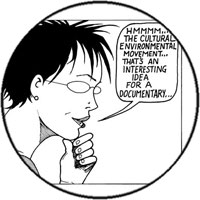
Copyright and Documentary Filmmaking: the Comic Book

A tight dressed, spiky haired filmmaker turns into a tight dressed, spiky haired superhero to fight expanding copyright restrictions. The Center for the Study of the Public Domain at Duke University School of Law has a novel way of presenting the current difficulties documentary filmmakers are facing. The comic book, Bound by Law? by Keith Aoki, James Boyle, and Jennifer Jenkins, presents an in depth explanation of the issues involved in using copyrighted material in documentary film. It also gives suggestions about what can be done to tip the balance back to support a more creative culture.

Wednesday, February 22, 2006

Open Campus Screenings and Copyright

There is a common misconception of permissible uses of copyrighted videos on campus that I thought should be mentioned. On a fairly regular basis a student group or academic department asks for permission to use a library copy of a feature film for an open screening, believing they are permitted to without acquiring public performance rights because it would be used in an educational setting. The truth is that the feature films in our collection, roughly 25% of our holdings, cannot be used for those screenings because they are sold with what are referred to as "home-use" rights. The reason "home-use" titles can be used in classes is that there is a face-to-face teaching exemption in the copyright law that allows it. There is a clear distinction however between the classroom and, say, an event where faculty or students are present and have a serious, scholarly discussion before or after the film. The latter scenario is not covered by the exemption. There are several requirements that must be met to qualify for the exemption but the one that seems to be least understood is that the performance must be incorporated in systematic instruction. Systematic instruction means, more or less, a formal class for which one would register.

Feature films are almost never sold with what is called "public performance rights", though many documentaries are, so if a campus group would like to hold an open screening of a feature film, and by that term I'm referring to what one might also call a "movie", it's necessary to either get permission from the copyright owner or pay for "public performance" rights for the particular screening, typically through a commercial distributor. The cost difference between the purchase of a home-use videotape and a one-time public performance license is usually substantial, along the lines of $20 vs. $200-$1000+. By the way, if a film is a documentary, one shouldn't assume we have public-performance rights for it. Many documentaries in the Media Services collection have only home-use rights (e.g. Fahrenheit 9/11, Control Room, March of the Penguins).

Distributors that commonly sell their documentaries with public-performance rights include PBS, Bullfrog, Cinema Guild, Filmakers Library, Films for the Humanities and Sciences, First Run Icarus, and Women Make Movies.

Here's a useful guide on the subject with a full explanation of the requirements of the face-to-face teaching exemption, from College of St. Benedict, St. John's University: Facts about video programming on campus.